AI Clothing Photography in 2026: Better Catalogs for Saree, Kurti & Lehenga Sellers
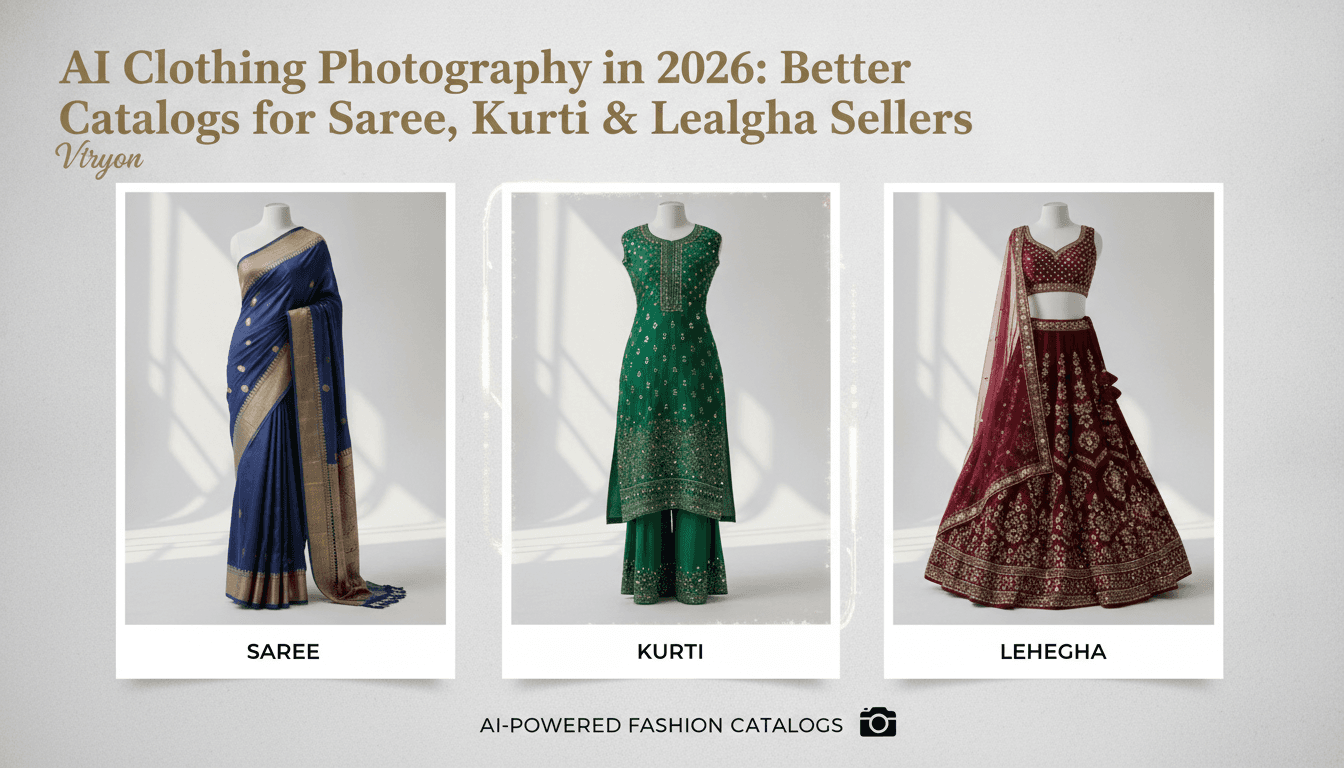
AI clothing photography has moved from experiment to workflow. In 2026, garment sellers are no longer asking whether generative AI can make attractive fashion images. They are asking a more practical question: can it produce catalog-ready visuals at scale without damaging garment truth? For saree, kurti, and lehenga sellers, that distinction matters. A beautiful image is not enough if the zari looks wrong, the pallu falls unnaturally, or the color of the dupatta shifts from product to product.
The good news is that newer systems are getting better at multi-turn editing, consistency across outputs, multilingual content support, and commercial asset creation. The caution is just as important: generic AI image tools still do not understand fashion merchandising on their own. Ethnic-wear catalogs need fashion-specific workflows that protect drape, embroidery, silhouette, and PDP clarity.
Why this matters now
Catalog production pressure has increased for fashion ecommerce teams. Brands need more SKUs, more poses, more marketplaces, more regional campaigns, and faster turnaround for launches. A single product may need a PDP hero image, alternate angles, marketplace crops, social creatives, WhatsApp catalog images, and regional-language ad variants. Traditional production can do this, but not always at the speed or cost structure that modern catalog teams want.
This is especially true for Indian sellers managing sarees, salwar kameez sets, kurtis, lehengas, and festive collections. Seasonal selling windows are short. Design turnover is high. Many Surat fashion businesses and distributed catalog teams need to launch new styles quickly, test demand quickly, and refresh creative without organizing a full shoot for every variation.
What changed in the latest image generation tech
The latest wave of multimodal image generation is more useful for commerce because it is better at following structured instructions over multiple edits. Instead of generating a single attractive image and starting over when something is wrong, teams can now refine outputs step by step: adjust pose, preserve fabric, change background, create a square crop, or localize text around the image for a campaign.
That matters for catalog creation. Fashion teams need repeatability more than novelty. They need the same garment to stay recognizable across multiple poses. They need model styling that does not fight the product. They need consistency across a collection, not one-off hero shots that look unrelated.
- Multi-turn editing: teams can iterate on a usable base image instead of regenerating from scratch every time.
- Better consistency controls: model identity, garment placement, framing, and background can stay more stable across a set.
- Commercial asset creation: one approved image can be adapted into PDP, marketplace, banner, and social formats.
- Multilingual output support: easier campaign adaptation for English, Hindi, Gujarati, and other regional contexts.
- Trust and provenance features: content credentials/C2PA and technologies such as SynthID are part of the broader conversation around identifying and managing AI-generated media.
Even with these advances, the best results still come from fashion-aware systems, not generic image generators. The technology has improved. The workflow still decides whether the result is ecommerce-ready.
Why garment sellers should care
For sellers, the value of AI clothing photography is not just lower shoot cost. It is operational flexibility. Teams can create more coverage from fewer source assets, test faster, localize creative faster, and reduce bottlenecks between merchandising, design, catalog, and marketing.
- Launch faster: turn a clean garment image into multiple model-led outputs without waiting for a full reshoot.
- Expand catalog coverage: create more poses, crops, and aspect ratios for PDPs and marketplaces.
- Support variant selling: adapt approved imagery for different color variants and campaign contexts.
- Improve consistency: keep collection pages visually aligned across categories and seasons.
- Sell across channels: repurpose assets for WooCommerce, marketplaces, social ads, and WhatsApp catalog flows.
This is useful for both large catalog teams and smaller sellers. A boutique ethnic-wear seller may want affordable model-led images without managing a studio every week. A larger fashion ecommerce brand may want to reduce repetitive production work while keeping real photoshoots for hero campaigns and premium launches.
Where generic AI clothing photography still fails
This is where buyers should stay careful. Generic AI tools are very good at making images that look polished at first glance. They are less reliable when the image must represent a real garment accurately enough for ecommerce. The failure mode is not always obvious until returns rise, customers complain, or the catalog team notices inconsistencies across SKUs.
- Fabric truth gets lost: silk, georgette, cotton, net, and velvet may be rendered with the wrong texture or weight.
- Drape becomes inaccurate: saree fall, pleats, pallu length, and dupatta placement may look elegant but unrealistic.
- Embroidery details blur: zari, sequins, borders, prints, and threadwork can become simplified or distorted.
- Color shifts happen: maroon becomes red, pastel mint becomes brighter green, or multiple outputs show different shades.
- Silhouette consistency breaks: a kurti hemline, lehenga flare, or sleeve style may subtly change between images.
- Accessory confusion appears: jewelry, footwear, or styling elements may distract from or misrepresent the product.
These weaknesses matter more in ethnic wear because the product story often sits in the details. A shopper may choose one saree over another because of border work, blouse pairing, pallu styling, or the exact feel of the embroidery. If AI smooths those details into something generic, the image becomes less useful even if it looks attractive.
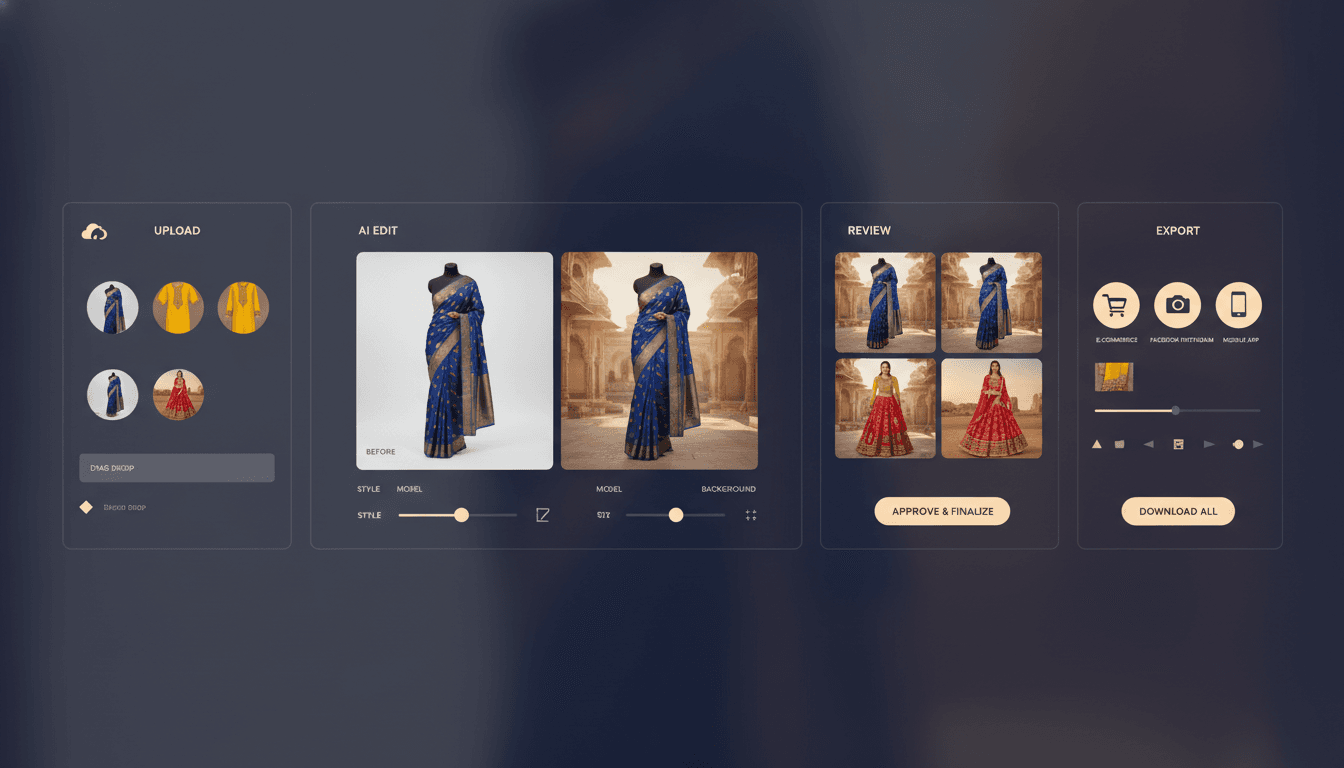
A practical workflow for fashion ecommerce teams
The most successful teams treat AI clothing photography as a production workflow, not as a prompt experiment. That usually starts with a strong input and a clear review process.
1. Start with the right input photo
Use a clean, well-lit garment image with minimal wrinkles and accurate color. Flat lay and ghost mannequin inputs can both work, but they should be sharp, evenly exposed, and free of distracting shadows. If the original image hides important fabric details, AI will not reliably recover them later.
2. Define the catalog goal before generating
Decide whether you need PDP images, marketplace images, banner creatives, multi-pose outputs, or regional campaign assets. A PDP hero image needs clarity and garment fidelity. A marketing banner can be more expressive. Mixing those goals in one generation step usually produces weaker results.
3. Use a fashion-specific model and pose workflow
An AI fashion model generator can speed up model-led outputs, but the workflow should preserve the garment rather than redesign it. Good tools let teams create multiple poses from one approved source while keeping product features stable. That is especially valuable for tops, kurtis, lehengas, and coordinated sets.
4. Review for merchandising accuracy
Have a human reviewer check hemline, sleeve shape, fit, border placement, print alignment, color accuracy, and texture detail. If you sell sarees, explicitly review pleats, pallu flow, blouse pairing, and border visibility. If you sell lehengas, check flare, paneling, and embroidery continuity.
5. Create channel-specific exports
Once a master image is approved, generate the required variations: vertical ad creatives, square marketplace crops, WooCommerce product images, and lightweight assets for WhatsApp catalog sharing. This is where AI becomes operationally powerful. One approved visual base can support multiple selling surfaces.
6. Keep provenance and workflow records
As AI-generated media becomes more common, teams should keep internal records of how assets were created and edited. Content credentials/C2PA and related provenance approaches are relevant here, especially for larger brands building repeatable governance around AI-assisted catalog production.
A special playbook for saree, kurti, and lehenga sellers
Indian and ethnic-wear sellers should be more strict than the average apparel merchant because the buying decision often depends on drape and detail. The playbook should reflect that.
- For sarees: make sure pleats, pallu length, border visibility, and fabric fall are reviewed in every output.
- For kurtis: check neckline shape, sleeve type, side slits, print placement, and hemline consistency.
- For lehengas: review flare volume, panel structure, dupatta styling, and embroidery continuity across folds.
- For salwar kameez sets: confirm that the kameez, bottom, and dupatta remain visually coherent as a set.
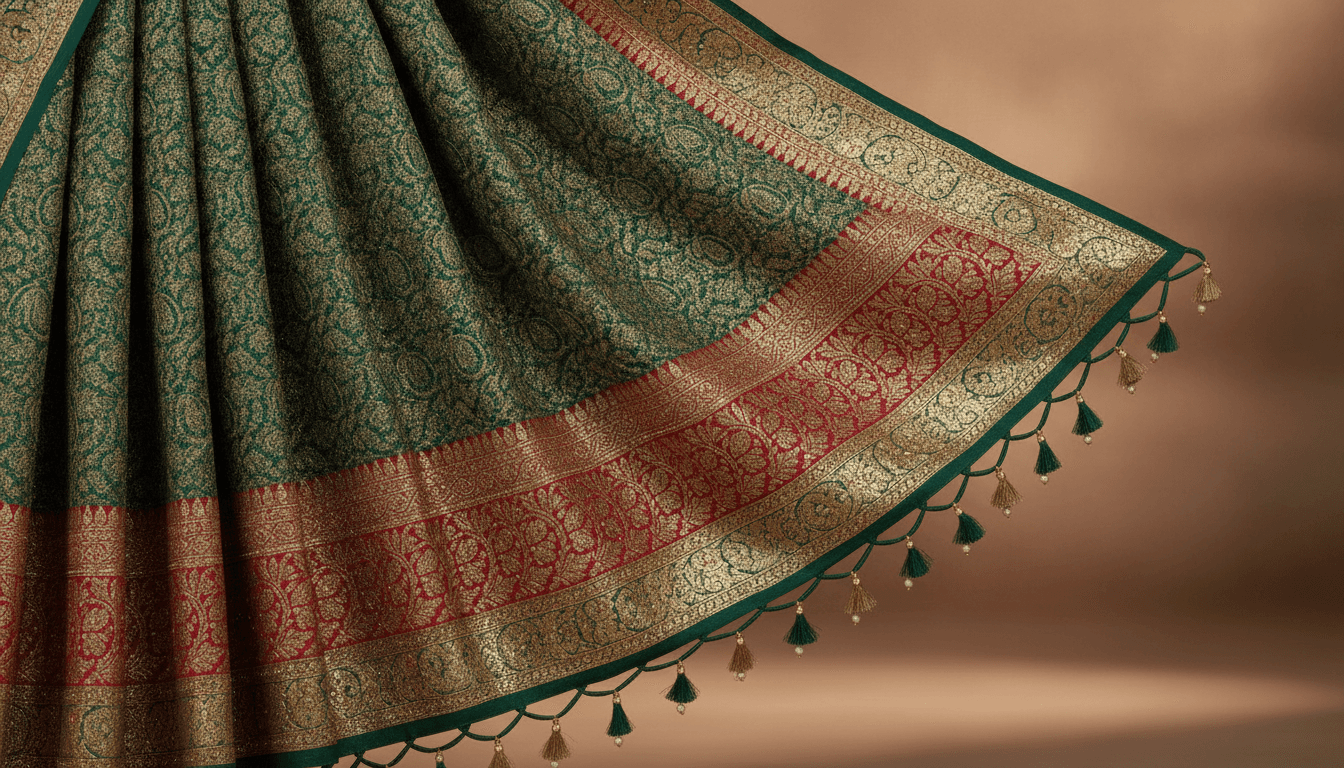
- For detail-led products: create zoom-friendly secondary assets that show zari, embroidery, prints, and trims clearly.
If your catalog depends heavily on regional buyers, also think about selling context. The same product may need a clean ecommerce PDP image, a festive campaign image, and a practical WhatsApp-ready version that is easy for resellers or sales associates to share. AI can help here, but only if the approved garment representation stays constant across those formats.
How to evaluate an AI clothing photography tool
Do not evaluate a tool on a single beautiful demo. Evaluate it on the repetitive work your team actually does. The right question is not "Can it make a nice fashion image?" The right question is "Can it make reliable product images for our catalog process?"
- Garment preservation: does the output stay faithful to the uploaded product?
- Pose consistency: can you generate multiple usable poses from one source?
- Color reliability: do color variants remain accurate and distinct?
- Detail retention: are embroidery, prints, borders, and texture preserved well enough for ecommerce?
- Channel readiness: can you create assets for PDPs, marketplaces, ads, and WhatsApp catalog use?
- Workflow fit: does it support your existing team process, from upload to review to export?
- Integration options: does it work with WooCommerce, API-based flows, or other commerce systems you already use?
For many teams, the best evaluation test is simple: choose 10 real SKUs from your catalog, including at least a few difficult ethnic-wear items, and compare AI outputs against your merchandising standards. If the tool succeeds only on easy western basics, it is not enough.
When to use AI vs a real photoshoot
AI clothing photography is not a total replacement for traditional production. It is a strong option for repeatable catalog creation, variant expansion, fast testing, and channel adaptation. A real photoshoot is still the better choice when the brand story depends on original art direction, celebrity talent, complex movement, premium campaign storytelling, or absolute confidence in fine material representation.
- Use AI when: you need faster catalog coverage, multiple poses, cost-efficient testing, or scalable assets from existing product photos.
- Use a real photoshoot when: you are launching a hero collection, running a brand campaign, featuring intricate couture pieces, or need highly controlled editorial styling.
- Use both when: you want a hybrid model—real photography for hero assets, AI for catalog expansion and downstream marketing formats.
That hybrid approach is often the most practical answer in 2026. It protects brand quality while removing repetitive production friction.
The bottom line
AI clothing photography is now good enough to be useful for real ecommerce work, but it is not automatically trustworthy. For saree, kurti, and lehenga sellers, the winning approach is clear: use newer generative AI systems for speed and scale, but keep a fashion-specific workflow that protects fabric truth, drape, color accuracy, and product detail.
If you want better catalogs in 2026, do not chase the most dramatic demo. Choose the workflow that helps your team create consistent, commerce-ready visuals across PDPs, marketplaces, and messaging channels without losing the garment itself.
Ready to test AI clothing photography on your catalog?
If your team sells sarees, kurtis, lehengas, or other fashion products online, the fastest way to evaluate AI is with your own garments. Start with a few real SKUs, compare results across poses and channels, and check whether the output is good enough for both merchandising and conversion.
Vtryon helps fashion sellers create practical AI imagery workflows for ecommerce—from model-led catalog creation to virtual try-on and scalable product visuals. If you want to see what this looks like on your products, book a demo or request a free sample.