AI Saree Catalog Photos: How Ethnic-Wear Sellers Create On-Model Images Without a Photoshoot
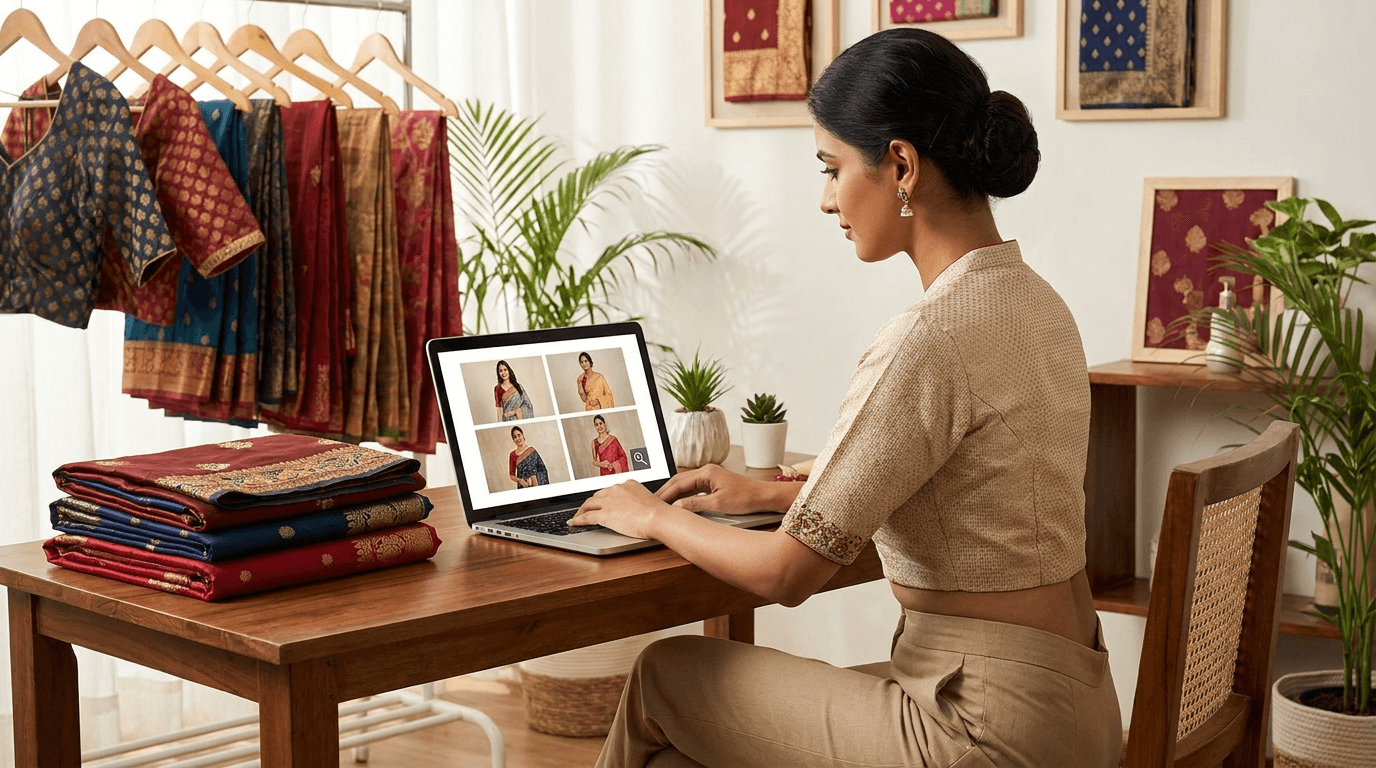
For saree sellers, catalog creation is rarely just about taking a few pretty pictures. A single collection can mean arranging drapes, finding the right model, checking blouse fit, correcting pallu placement, managing studio time, and then repeating the process for Banarasi, Kanjivaram, georgette, chiffon, lehengas, kurtis, and salwar suits. That is why more boutiques, wholesalers, textile shops, and D2C fashion brands are exploring AI saree draping as a practical way to create on-model images without a full photoshoot.
The real question is not whether AI can generate a fashionable image. It is whether it can produce usable catalog photos that preserve the saree's selling details: pleats, pallu flow, border alignment, blouse styling, zari texture, and print clarity. If you are evaluating AI saree catalog photos for your business, this guide will help you judge where it works, what inputs matter, and when a physical shoot still makes more sense.
Why saree catalog production is slow and expensive
Ethnic-wear photography is harder than standard western-wear product photography because the garment's shape is not fixed. A saree changes dramatically based on draping style, pleat neatness, shoulder fall, blouse cut, body pose, and fabric behavior. Sellers are not only showing color and pattern; they are selling how the garment falls on the body.
- Styling complexity: Sarees, dupattas, lehengas, and suits need correct arrangement before the camera even starts shooting.
- Repeated labor: Every SKU may need steaming, pinning, re-draping, and pose changes.
- High coordination cost: Model, makeup, studio, photographer, stylist, and post-production all add time and budget.
- Inconsistent output: Different shoot days can create variation in skin tone, lighting, angles, and presentation.
- Channel pressure: You do not just need website images. You may also need assets for Instagram, marketplaces, and WhatsApp catalog images for sarees.
What AI saree draping actually means
AI saree draping is not just a generic image generator making a nice fashion picture from a text prompt. In a catalog workflow, it means using your garment image and applying it onto a model presentation in a way that keeps the saree recognizable and sellable. The better systems aim to preserve garment identity while generating realistic model images, pose variations, and channel-ready outputs.
For a seller, the value is operational: you can turn one strong product input into ai model photoshoot for sarees outputs that look closer to planned catalog photography, without re-running a physical studio process for every design. The same logic can extend to lehenga catalog images ai, kurti catalog photos ai, and other ethnic-wear categories.
The best input images for AI saree catalog photos
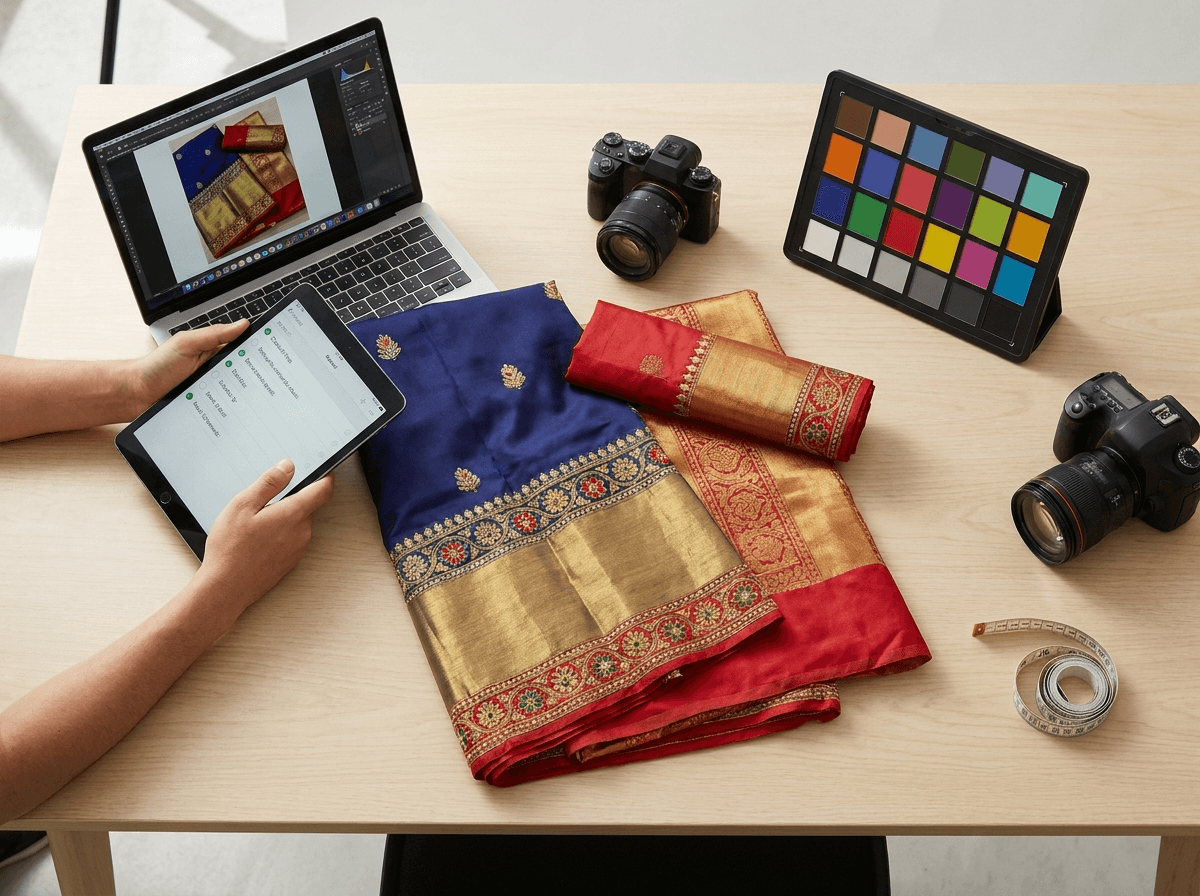
If your source image is weak, AI will guess. Guessing is exactly what you do not want when the border design, zari work, or blouse pairing affects the sale. The best-performing inputs are usually bright, straight, undistorted garment photos with visible detail and minimal background distraction.
- Use high-resolution garment photos: The pallu, border, motifs, and weave should be visibly sharp.
- Keep lighting even: Avoid deep shadows, yellow indoor color cast, or blown-out highlights on reflective zari.
- Show true color: This matters for bridal reds, jewel tones, pastel organza, and printed daily-wear sarees.
- Capture important sections: If the pallu or border is the hero detail, make sure it is clearly present in the input.
- Use clean background separation: The more clearly the garment stands out, the easier it is to map accurately.
- Maintain consistency across the catalog: Similar angles and garment prep help when scaling to many SKUs.
Your quality checklist: what to inspect before using AI images commercially
Do not approve an AI saree image just because it looks attractive at first glance. Zoom in like a buyer. A good catalog image should survive close inspection on product pages, social posts, and reseller sharing.
- Pleats: Are they neat, believable, and evenly falling, or do they melt into each other?
- Pallu placement: Does the pallu sit naturally across the shoulder or arm without disappearing or twisting unnaturally?
- Border alignment: Are borders continuous and positioned correctly, especially near the hem and pallu edge?
- Blouse compatibility: Does the blouse look intentional in cut, sleeve, color, and neckline, or like an unrelated add-on?
- Zari and print detail: Are metallic elements, motifs, embroidery, or patterns preserved instead of blurred or invented?
- Fabric behavior: Does chiffon look fluid, georgette look light, and silk look structured?
- Hands and body intersections: Check where arms, waist, and drape overlap for broken edges or warped cloth.
- Commercial realism: Ask whether a shopper would feel misled if the delivered product matched the garment but not the image styling.
How to scale from one image to a full ethnic-wear catalog
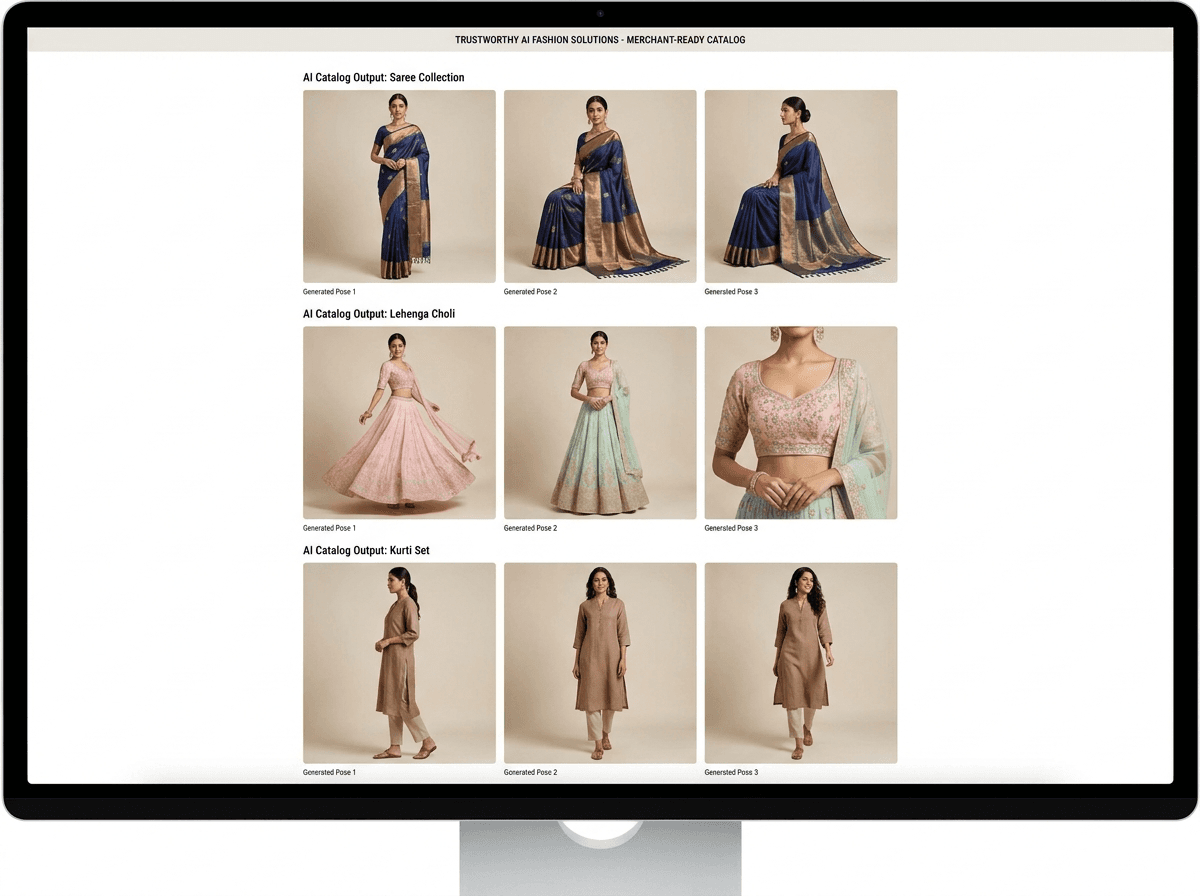
The biggest advantage of ai product photography for ethnic wear is not one hero image. It is repeatability. Once a seller has a clean workflow, the same garment can be rendered into consistent product-page imagery, Instagram creatives, and reseller-friendly exports. This is especially useful for boutiques and wholesalers managing fast-moving collections from hubs such as Surat.
- Start with a controlled test batch: Run 10 to 20 SKUs before committing your entire catalog.
- Lock a model direction: Keep face style, body framing, and pose family consistent across a collection.
- Generate multiple poses: Front, 3/4, walking, and detail-friendly poses can make one garment more reusable.
- Use recolor carefully: Recolor is powerful for variants, but always compare against the true product shade.
- Export by channel: Prepare separate crops for website PDPs, Instagram grids, marketplace ratios, and WhatsApp sharing.
- Create category logic: Sarees may need more drape-sensitive outputs, while kurtis and suits may scale faster with simpler structure.
When AI works best for sarees, lehengas, kurtis, and salwar suits
AI usually performs best when the seller needs speed, consistency, and broad catalog coverage rather than editorial storytelling. It is especially useful for standard catalog presentation, new arrivals, reseller distribution, and testing many designs before choosing a few for premium campaigns.
- Sarees: Best when the input clearly shows border, pallu, and fabric behavior, and the goal is clean catalog presentation.
- Lehengas: Strong fit for front-facing and slightly angled views where skirt volume and blouse styling are important.
- Kurtis: Often easier to scale because the silhouette is more stable and the garment structure is simpler.
- Salwar suits with dupatta: Good when the dupatta placement remains readable and the output keeps the set visually coordinated.
When a real photoshoot still makes sense
AI is not a total replacement for every fashion shoot. Physical photography still matters when tactile authenticity or brand storytelling is the main job of the image.
- Ultra-premium bridal collections: Heavy embroidery, layered craftsmanship, and luxury positioning often deserve full art direction.
- Close-up fabric storytelling: If handwork, weave depth, or sheen variation is central to the sale, macro photography still matters.
- Campaign and brand films: Lifestyle shoots, motion content, and celebrity-led launches need real production.
- Very complex draping styles: If the exact drape method is the product story, a physical stylist may still be safer.
- Wholesale trust-building: Some buyers still want a mix of AI catalog efficiency plus real-shot proof images.
“The best AI catalog workflow does not hide the garment. It makes the garment easier to sell, faster to publish, and cheaper to scale.”
— Vtryon Editorial
How to evaluate an AI vendor before you commit
Ask for a real sample run using your own sarees, not generic demos. Compare output consistency across silk, printed, bordered, and embellished styles. Review whether the platform supports your needs beyond one image, such as multiple poses, recolor workflows, channel-ready exports, and catalog production at scale. If you sell across website, Instagram, and WhatsApp, the workflow matters just as much as the image itself.
If you want to reduce the cost and delay of a saree photoshoot without model while keeping the garment recognizable, AI can be a strong operational upgrade. Start small, inspect details ruthlessly, and expand only after you trust the output on real SKUs. For many ethnic-wear sellers, that is the practical path to faster catalog launches with less production overhead.
Ready to test this on your own catalog? Explore Vtryon's product workflow, compare pricing, review recolor and multiple-pose options, and request a demo on a small saree batch before rolling it out to your full collection.