Google Gemini vs Vtryon for Fashion Ecommerce

If you are comparing Google Gemini vs Vtryon, the first thing to get clear is that this is not a simple one-to-one product battle. Both use AI. Both can help a fashion business move faster. But they solve very different problems inside the ecommerce workflow. Gemini is a general AI assistant for thinking, planning, drafting, analyzing, and answering. Vtryon is a fashion-focused platform built to turn garment photos into seller-ready visuals like virtual try-on outputs, AI model imagery, recolors, and pose variations.
That distinction matters because garment sellers do not buy AI for abstract reasons. They buy it to remove bottlenecks. One bottleneck is decision-making: planning a collection launch, writing product copy, organizing merchandising data, or summarizing customer feedback. Another bottleneck is visual production: getting the outfit onto a believable model, creating multiple angles, showcasing color variants, and publishing a clean catalog without waiting for a full studio shoot. Gemini is strong on the first category. Vtryon is built for the second.
Short answer: these are different tools for different jobs
The most useful answer for fashion sellers is not "Which AI is better overall?" It is "Which AI owns the problem I need solved this week?" If your team needs help with research, naming, campaign ideas, spreadsheet analysis, or product-description drafts, Gemini is useful. If your team needs catalog visuals, model shots, virtual try-on results, ethnic-wear presentation, or image consistency across many SKUs, Vtryon is the more relevant tool.
“The right comparison is not model versus model. It is workflow versus workflow.”
— Vtryon Editorial
What Google Gemini is good at for fashion sellers
Gemini is best understood as a flexible, multimodal AI assistant. A fashion brand can use it to brainstorm campaign angles, analyze product sheets, summarize vendor conversations, organize customer reviews, compare competitor positioning, draft ads, rewrite product titles, and turn rough merchandising notes into structured launch plans. For a founder, marketer, merchandiser, or operations lead, that can save serious time.
This is especially helpful in fast-moving catalog businesses where the team is juggling WhatsApp selling, marketplace listings, website updates, ad creatives, and seasonal launches all at once. Gemini can help you think faster, write faster, and sort information faster. It can turn messy inputs into usable decisions.
- Collection planning: brainstorm launch themes, naming ideas, and seasonal merchandising angles.
- Copywriting support: draft product descriptions, ad hooks, size-guide blurbs, and email campaigns.
- Analysis: summarize customer reviews, compare competitors, and organize market research.
- Operations: turn spreadsheets, notes, and files into cleaner reports or action lists.
- Team productivity: help founders and ecommerce managers move from raw information to decisions.
What Gemini does not do by itself is give a garment seller a dedicated fashion-production workflow. It can describe a saree beautifully. It can suggest how to launch a lehenga edit. It can help write SEO copy for a kurti collection. But that is still different from actually generating the on-model catalog asset your product page needs.
What Vtryon is built to do
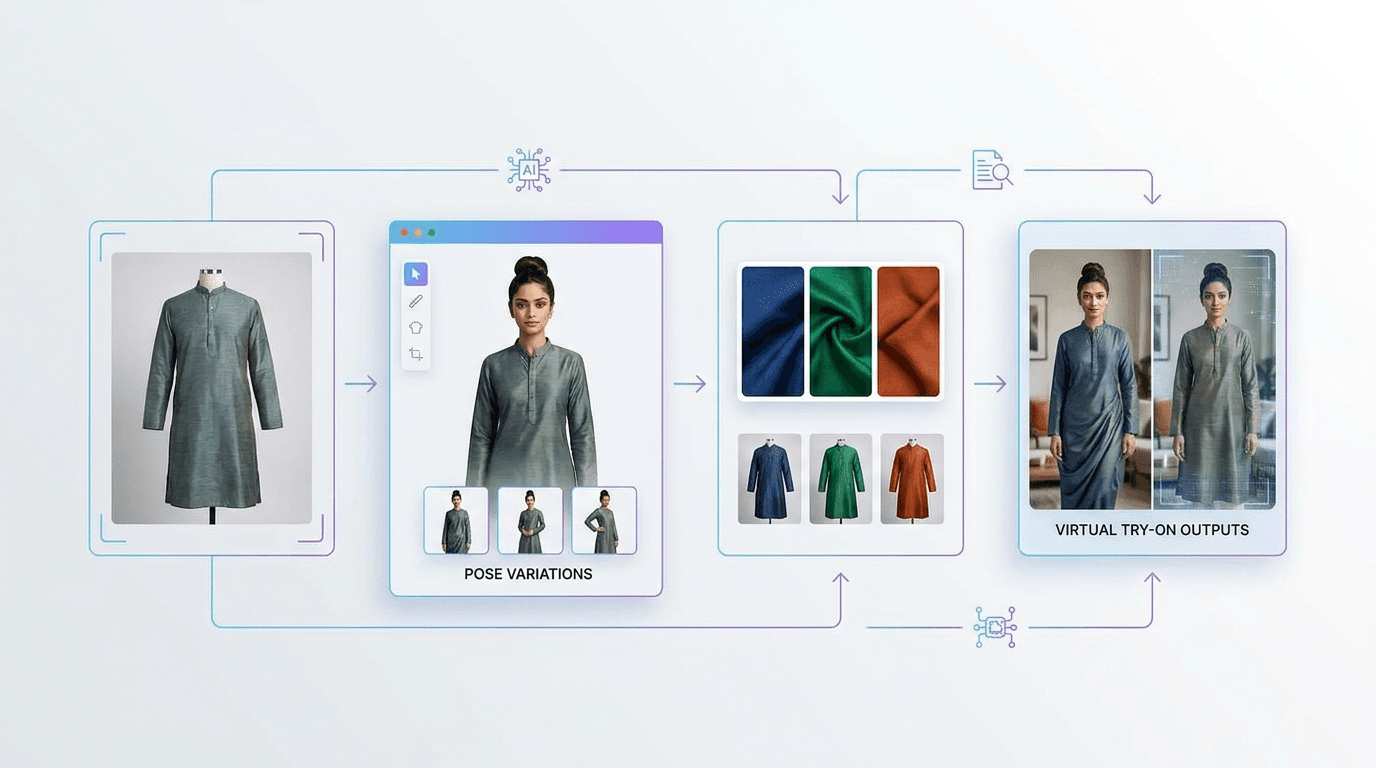
Vtryon is much narrower than Gemini, and that is exactly the point. It is specialized for fashion ecommerce visuals. Instead of acting like a general assistant, it is built around seller workflows: upload garment images, generate AI model imagery, run virtual try-on, create multiple poses, produce recolor variants, and prepare fashion visuals that are usable in catalogs, product pages, social content, and sales material.
That makes Vtryon more relevant when your problem is not "What should I say about this product?" but "How do I show this product professionally, consistently, and at scale?" For brands selling sarees, lehengas, kurtis, dresses, menswear, and kidswear, the visual layer is not optional. It is the storefront.
- AI fashion model imagery: turn garment inputs into studio-style model visuals.
- Virtual try-on: show how the product looks when worn rather than only as a flat image.
- Multi-pose output: create more angles and presentation variety for the same SKU.
- Recolor workflows: showcase additional colorways without repeating the full process.
- Catalog consistency: keep background, style, and presentation aligned across many products.
- Seller workflow fit: useful for catalog teams, boutiques, wholesalers, D2C brands, and manufacturers.
Where Gemini and Vtryon overlap
There is some overlap, but it is light. Both tools sit somewhere inside the broader AI stack a modern ecommerce team may use. Both can speed up work. Both can support merchandising and product presentation in indirect ways. And both can be valuable to a lean team that cannot afford slow manual workflows.
But the overlap is mostly around business outcomes, not product behavior. Both may help you launch faster. Both may help you improve the quality of what reaches the customer. Both may reduce creative friction. Yet the way they do that is very different: Gemini helps through intelligence and planning, while Vtryon helps through specialized visual execution.
Quick comparison table
- Primary job: Gemini = general AI for reasoning, drafting, summarizing, and analysis. Vtryon = fashion-specific visual creation and virtual try-on workflows.
- Best user: Gemini = founder, marketer, merchandiser, operations lead. Vtryon = catalog team, ecommerce team, creative team, boutique owner, manufacturer.
- Main output: Gemini = ideas, copy, summaries, structured thinking. Vtryon = model images, try-on visuals, poses, recolors, catalog assets.
- Workflow stage: Gemini = pre-production and decision support. Vtryon = production and merchandising execution.
- Fashion specialization: Gemini = broad and flexible, but not purpose-built for garment visualization. Vtryon = built around fashion presentation needs.
- Customer-facing try-on story: Google has shopper-facing try-on experiences, but Vtryon is oriented around seller-controlled catalog and storefront workflows.
- Ethnic-wear readiness: Gemini can help describe ethnic products; Vtryon is the better fit when you need those garments visually presented at scale.
- Store context: Gemini helps any team selling on WooCommerce, Shopify, marketplaces, or WhatsApp. Vtryon becomes more valuable when those channels need repeatable visual assets.
- Can it replace a fashion photoshoot workflow?: Gemini = no. Vtryon = often yes for many routine catalog use cases.
Visual suggestion for the design team: turn the comparison above into a mobile-friendly 2-column chart with rows for job-to-be-done, outputs, buyer stage, ethnic-wear fit, and store workflow.
Can Gemini replace a fashion virtual try-on platform?
In most seller workflows, no. And it is important to explain that carefully. Saying that Google has "no try-on" would be misleading. Google does have consumer-facing virtual try-on experiences in Shopping, and Google also launched Doppl as a separate consumer app for experimenting with outfits. But those are not the same thing as a seller-focused platform built to generate catalog assets, model variations, recolors, and repeatable merchandising outputs.
That is the real dividing line. Google's public try-on experiences are built around helping shoppers explore products in Google's ecosystem. Vtryon is built around helping sellers create and control the visual assets they need for ecommerce. If you run a D2C fashion store, a boutique catalog operation, or a manufacturing-led sales team, that seller-side control is usually the deciding factor.
Why specialization matters in fashion ecommerce
Fashion is one of those categories where "good enough AI" often fails at the last mile. A generic tool may be impressive in a demo and still be weak where it counts: neckline accuracy, print placement, sleeve shape, drape, fall, border continuity, color consistency, or how a garment reads across multiple poses. These details are not cosmetic. They are how sellers communicate value.
That is why specialized tools keep winning inside narrow but high-value workflows. A garment seller does not need an AI that can talk about everything. They need an AI that can help sell clothing without creating more manual cleanup. In practice, specialization matters when your brand depends on speed, consistency, and believable product presentation.
- Merchandising detail: fashion teams care about texture, silhouette, drape, and styling coherence.
- Catalog scale: one collection may require dozens or hundreds of related outputs.
- Brand consistency: poses, backgrounds, and model presentation need to feel intentional, not random.
- Operational speed: sellers need assets fast enough to support launches, resellers, and seasonal drops.
- Commercial reality: visuals do not exist for inspiration alone; they exist to help someone buy.
The India and ethnic-wear angle changes the decision
This comparison becomes even clearer in the Indian market. Many global AI fashion conversations are still shaped by western-style ecommerce use cases. But Indian sellers often work with garments that are harder to present well: sarees, lehengas, kurtis, suits, layered sets, embroidery-heavy pieces, and products where border placement, drape, and styling context matter as much as the silhouette.
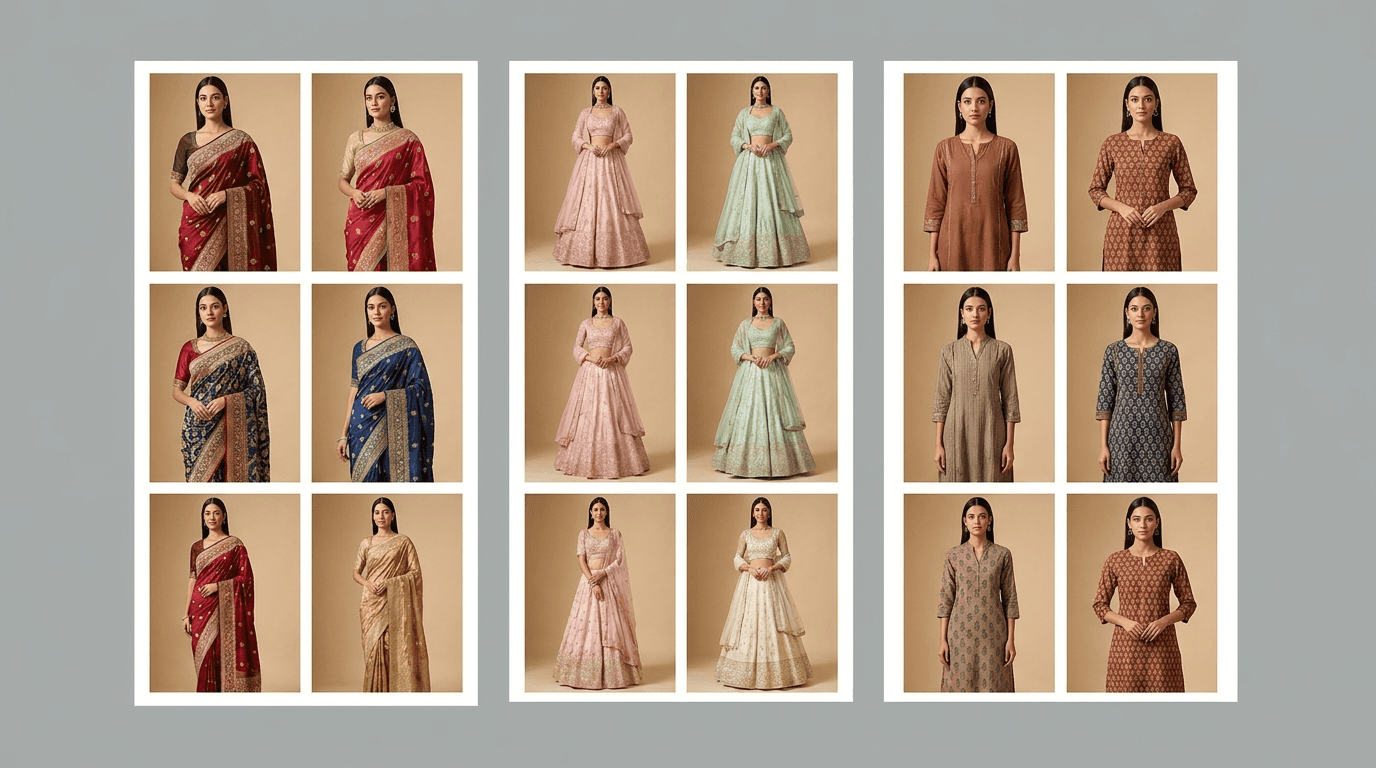
For those sellers, the question is not whether Gemini is useful. It is. The question is whether a general AI assistant can substitute for a fashion visual workflow tuned to how ethnic products are actually sold. Usually it cannot. A seller in Surat, Mumbai, Jaipur, Ahmedabad, or Delhi may use Gemini to plan a festive edit, write campaign copy, or compare demand trends. But when it is time to show the saree, not describe the saree, a fashion-focused tool becomes much more important.
This is also where Vtryon's positioning makes sense. The platform is aligned with seller workflows around AI model imagery, try-on, recolor, poses, and catalog generation, and its public positioning already speaks directly to ethnic wear and high-volume garment-selling realities.
Best use cases for Gemini
- Product copy at scale: draft first-pass titles, bullets, descriptions, and ad hooks for large catalogs.
- Collection planning: map launch calendars for festive, bridal, wedding-season, or summer edits.
- Review mining: summarize customer complaints and identify recurring sizing, fabric, or styling concerns.
- Competitive research: compare messaging and assortment gaps across other fashion brands.
- Store operations: analyze spreadsheets, vendor notes, and merchandising files to support decisions.
- Team ideation: generate campaign names, social concepts, shoot briefs, and landing-page outlines.
Best use cases for Vtryon
- Virtual try-on for product presentation: give buyers a clearer sense of how a garment looks when worn.
- AI model catalog creation: produce on-model visuals without organizing a full photoshoot.
- Multi-pose outputs: create more merchandising angles for PDPs, lookbooks, and social selling.
- Recolor at speed: show multiple color variants while keeping the core presentation consistent.
- Ethnic-wear merchandising: present sarees, lehengas, kurtis, and suits in a more scalable digital workflow.
- Seller-ready asset generation: support catalog, website, ad, and reseller material from the same garment base.
For many brands, the best answer is both
This is the practical conclusion most serious fashion teams reach. Use Gemini as the strategic assistant. Use Vtryon as the visual production engine. One helps you decide what to launch, how to message it, and how to structure the work. The other helps you create the actual fashion outputs that shoppers, resellers, and buyers will judge.
- Step 1: use Gemini to analyze demand, plan the collection story, and draft product messaging.
- Step 2: use Vtryon to generate model visuals, virtual try-on images, poses, and color variants.
- Step 3: publish stronger PDPs, social creatives, WhatsApp selling assets, and reseller catalogs.
- Step 4: feed performance insights back into Gemini for the next campaign cycle.

How to decide this week
If you want a fast decision instead of a long evaluation cycle, ask four simple questions. First, is your current bottleneck thinking or production? Second, do you mostly need better words or better visuals? Third, are you selling fashion where drape, styling, and model presentation directly affect trust? Fourth, are you trying to reduce the time and cost between receiving a garment image and publishing a sellable asset?
If your answers point to planning, research, or copy, start with Gemini. If they point to product presentation, virtual try-on, model imagery, recolor, or ethnic-wear catalog creation, start with Vtryon. And if your team is scaling fast, use both instead of forcing one tool to do a job it was never designed for.
For internal linking, this post naturally pairs with Vtryon articles like What Is AI Virtual Try-On and How Does It Work for Garment Sellers?, Benefits of AI Try-On for Saree, Kurti, and Lehenga Sellers, Step-by-Step Guide: Running Your First Virtual Try-On Successfully, and How AI Recoloring Helps Fashion Sellers Showcase Multiple Color Variants.
Final takeaway
The cleanest way to think about Google Gemini vs Vtryon is this: Gemini helps fashion sellers think, plan, write, and analyze. Vtryon helps fashion sellers show, scale, and merchandise. Those are both valuable jobs. They are just not the same job.
- Use Gemini when the work starts with information, prompts, copy, research, or decision support.
- Use Vtryon when the work starts with garments and needs to end in convincing ecommerce visuals.
- Choose specialization when image quality, consistency, and fashion workflow control matter.
- Think stack, not showdown: the best AI setup is usually a combination of general intelligence and domain-specific execution.
If your team wants to see the difference in a real business workflow, do not compare demo screens. Compare outputs. Give Gemini your next collection brief. Give Vtryon one live garment. By the end of the week, you will know exactly which part of the stack each tool should own.